

Frequently Asked Questions About the Boston Tea Party
Why did the Boston Tea Party take place at Old South Meeting House?
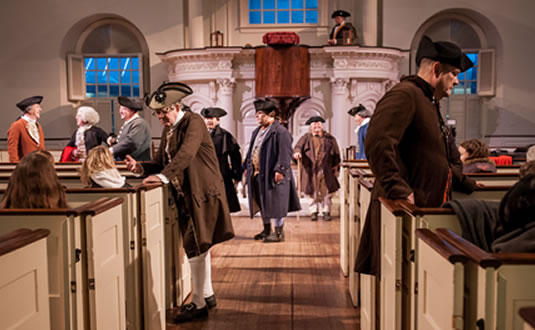
In the years leading up to the American Revolution, many public meetings too large for Faneuil Hall, the usual meeting place for the Town of Boston, were moved to the Meeting House. Old South Meeting House was the scene of some of the most dramatic and stirring meetings leading up to the American Revolution, including the Boston Massacre orations, and the 1768 meeting to protest the impressment of sailors into the British Navy.
Several meetings led to the Boston Tea Party. Colonists gathered to find resolution to the tea crisis on November 29 and 30 and on December 16, 1773. Read more about the Revolutionary meetings at Old South Meeting House on our History pages.
Where did the Boston Tea Party take place?
The large tea tax debates that decided the fate of the tea took place at Old South Meeting House. The "destruction of the tea," as it was called, took place at Boston Harbor on December 16, 1773. The three tea ships Beaver, Dartmouth and Eleanor were docked at what was known as Griffin’s Wharf in 1773, just a few blocks away from Old South Meeting House. Griffin’s Wharf no longer exists today because of massive landfill projects in the 19th century that dramatically changed Boston’s wharves and shoreline. The site is no longer underwater, but a historical marker on the corner of Congress and Purchase streets shows where Griffin’s Wharf once stood.
Why did the Boston Tea Party participants dress as Indians?
Although many images of the Boston Tea Party portray colonists dressed in full feather headdresses and leather hides as they marched to Griffin’s Wharf to dump the tea into the Harbor, firsthand accounts make it clear this was not the case.
Destroying the tea was an act of treason; as a result, many men did disguise themselves as Indians to hide their identity. According to eyewitness accounts, “Indian dress” at the Boston Tea Party consisted of blankets or ragged clothing and lampblack or soot. Some participants even carried hatchets to help break open the chests.
What kind of tea was destroyed at the Boston Tea Party?
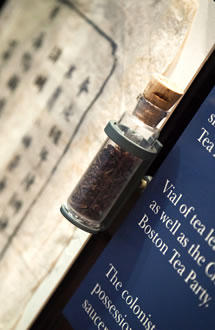
340 chests of tea were destroyed at the Boston Tea Party. Historians tell us that several varieties of black and green teas were aboard the ships, including Bohea, Congou, Souchong, Singlo, and Hyson. "Bohea" was a term used for black tea in the 18th century tea trade. Bohea tea came from the Wuyi Mountains in Fujian Province, China. Despite the fact that the English importer of the tea was called the "East India Tea Company," the tea that was cast overboard in the Boston Tea Party was from China, not from India, as many have mistakenly assumed.
How much tea was destroyed and what would it be worth today?
Participants in the tea party destroyed 340 chests of tea on the night of December 16, 1773. According to Charles Bahne, author of The Complete Guide to Boston’s Freedom Trail, this amounted to more than 46 tons of tea leaves. Such an amount could have brewed 18,523,000 cups of tea! The East India Company reported losses of £9,659 after the Boston Tea Party. This would amount to nearly two million dollars in today’s money!
Who participated in the Boston Tea Party?
It is well known that patriots Samuel Adams, Josiah Quincy and John Hancock were present at the December 16, 1773 meeting at the Old South Meeting House preceding the dumping of the tea. However, the men who actually destroyed the tea at Griffin’s Wharf are less well-known. Most of the estimated 100 to 150 Boston Tea Party participants remained anonymous for many years for fear of punishment. Among the purported participants, the best known are silversmith and patriot Paul Revere, and Dr. Thomas Young, John Adams' family physician. George Robert Twelves Hewes, a 31-year-old shoemaker (whose statue stands in the exhibit at Old South Meeting House), told the story of his participation in the Boston Tea Party to a journalist in 1835 when he was in his 90s. His account can be read in Alfred Young’s book The Shoemaker and the Tea Party: Memory and the American Revolution.
Click here to see a complete list of Boston Tea Party participants